The email landed in my inbox on a grey Tuesday morning in Brighton. Subject line in all caps: “I DID IT – 45 DAYS FOR $1,200.” The sender was a guy named Tom, a former colleague from a marketing agency I’d worked at years ago. He’d quit his job in January, bought a one-way ticket to Bangkok, and told everyone he was going to “figure things out.” Most of us thought he’d be back in three weeks, broke and sunburned.
Forty-five days later, he sent me a spreadsheet. Not a rough estimate. A colour-coded, formula-driven, category-by-category breakdown of every single baht, ringgit, and dong he’d spent. The total at the bottom said $1,214. He’d even included the ATM fees.
I called him immediately. “How?”
“I used your travel budget calculator,” he said. “But I also made rules. No hotels over $10 a night. No flights – only buses and trains. Street food only. And I tracked everything. Every coffee. Every bottle of water.”
Tom isn’t a hardcore budget traveller. He’s a 34-year-old graphic designer who used to spend £6 on oat milk lattes without blinking. But he was determined to make his savings last. And he did.
The Travel Budget Calculator was the tool he started with, before he even booked his flight.
He plugged in “Southeast Asia – backpacker style – 45 days.” The calculator spat out a range: $1,100 to $1,500. He set his target at $1,200. Then he broke that target down by country: Thailand, Cambodia, Vietnam, Malaysia, Singapore (just two days, because Singapore is expensive.
The To startthing he learned was that not all places in “cheap” Southeast Asia are equally cheap. Singapore was brutal. A hostel dorm bed there cost him $18 – more than double what he paid in Thailand. He only stayed two nights, then crossed into Malaysia and felt his daily average drop immediately.
The Trip Cost Estimator helped him adjust his daily targets when he spent more in one place.
Tom updated the estimator every three days. When he overspent on a cooking class in Chiang Mai ($15, he cut back on souvenirs. When he found cheaper accommodation than expected in Siem Reap ($6 a night instead of $10, he moved that money to a nicer hostel in Ho Chi Minh City. The estimator kept him honest.
Let me walk you through his actual numbers.
Accommodation: $378. That’s an average of $8.40 a night. Hostels mostly. A few guesthouses in Cambodia where he paid $6 for a private room with a fan and a mosquito net. He avoided booking through apps as much as possible. Instead, he walked into places and asked for the “walk-in rate.” In Chiang Mai, that saved him $3 a night compared to the Agoda price. Over two weeks, that’s $42 – two more nights of accommodation.
He learned a trick that I’ve used myself: if a hostel on Hostelworld says $10, walk in and offer $8 cash. Half the time, they say yes. They save the booking platform fee, you save money. Everyone wins.
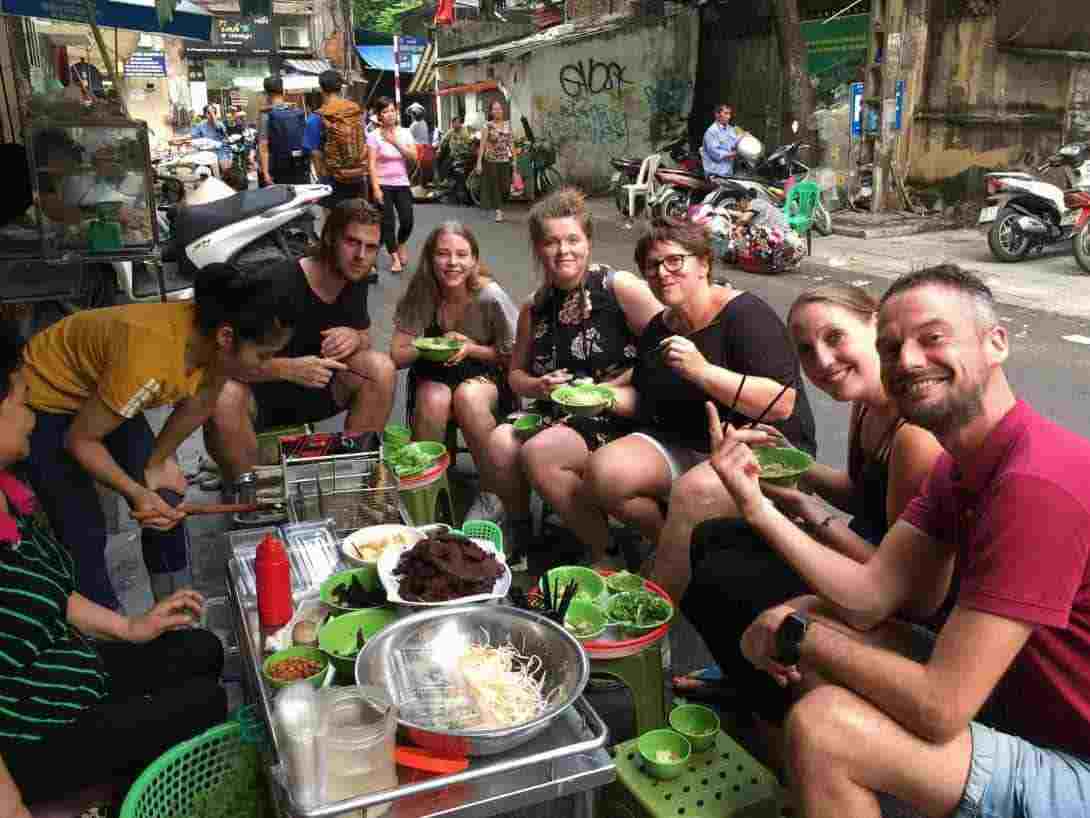
Food: $245. That’s $5.40 a day. Street food three times a day. Pad Thai for 40 baht ($1.10. Pho for 30,000 dong ($1.30. Nasi goreng for 8 ringgit ($1.70. He drank tap water where it was safe (Malaysia, Singaporeand bought large bottles where it wasn’t. He didn’t step into a single Western restaurant. He said “I can eat a burger at home.”
One night in Hanoi, he was exhausted and lonely. He almost bought a $12 pizza from an Italian place. He stood outside for two minutes, checked his budget on his phone, and walked back to the pho stall. He told me later that the pho was better anyway.
Transportation: $320. No flights inside the region. Buses, trains, and one ferry. The sleeper train from Bangkok to Chiang Mai cost him $22. The bus from Siem Reap to Ho Chi Minh City was $15 – twelve hours, but it saved him $80 compared to flying. He took a private minivan from Hanoi to Ha Long Bay for $12. The only splurge was a 2-day motorbike rental in the Vietnamese countryside – $8 including petrol. He covered over 300 kilometres.
He said the overnight trains were brutal at first. The beds are narrow. The air conditioning is arctic. The noise keeps you awake. But by the Thenone, he’d figured out the earplugs and eye mask system, and he actually looked forward to waking up in a new city.
Activities and entrance fees: $145. Angkor Wat’s three-day pass was $62 – the single biggest expense of the trip. He said it was worth every cent. He also paid for a cooking class in Chiang Mai ($15, a kayak tour in Ha Long Bay ($12, and a few temple entrance fees ($1-3 each. He skipped the “tourist trap” activities – no elephant rides, no floating village boat tours that cost $40.
He told me something interesting about Angkor Wat. The $62 pass felt painful to buy. But he spent three days exploring temples, and by the end of day two, he’d already forgotten what he paid. The memory of the sunrise over Angkor Wat was worth more than the money.
Miscellaneous: $76. This included travel insurance ($25 for 45 days, a local SIM card ($8, laundry ($0.50 per kg, and ATM fees ($12 total. He also bought a After thatpower bank after his To startone broke – $10.
The ATM fees surprised him. He didn’t realise that Thai ATMs charge 220 baht ($6per withdrawal. He started taking out larger amounts less often. That one change saved him about $30 over the trip.
Emergency contingency: $50. He didn’t touch it. But he said having it in his mental budget kept him from panicking when his bag strap broke and he had to buy a cheap replacement.
Total: $1,214. $14 over his target. He didn’t care.
The Digital Nomad Budget Planner isn’t just for remote workers – it’s for anyone who wants to compare spending patterns across cities.
Tom used it to compare Chiang Mai, Siem Reap, Ho Chi Minh City, and Kuala Lumpur. He saw that Chiang Mai was cheapest for accommodation ($8/night averagebut more expensive for activities. Kuala Lumpur was pricier for rooms but had cheap food courts. That helped him decide how many days to spend in each place.
Without that comparison, he might have stayed too long in Chiang Mai and run out of money before Kuala Lumpur. Instead, he balanced his itinerary perfectly.
I asked Tom what he would have done differently. He said “I’d have spent the extra $50 to fly from Bangkok to Chiang Mai instead of taking the train. The train was fine, but it ate a whole day.” That’s the thing about budget travel – time is also a currency. He saved money but lost time. He was okay with that trade-off. Not everyone would be.
Another traveller I know, a woman named Sarah, tried to copy Tom’s budget exactly. She went to the same places, stayed in the same hostels, ate at the same street stalls. She ran out of money after 31 days. Why? Because she didn’t account for her own spending habits. She bought coffee from cafés instead of 7‑Eleven. She took a $30 snorkelling trip that Tom had skipped. She upgraded to a private room twice when she couldn’t sleep in a dorm. Her daily average ended up at $38 instead of Tom’s $27.
The Travel Budget Calculator helps you set a target. The Trip Cost Estimator helps you stay on target. But neither tool can force you to choose the cheaper option. That part is up to you.
A few weeks after Tom got back, a friend of his asked him for budgeting advice. That friend booked a flight to Bali instead. He spent $2,500 in three weeks. Not because Bali is more expensive – because he stayed in resorts, ate at restaurants, and went on expensive day trips. Different priorities. Nothing wrong with that. But he didn’t use a budget tool, and he read the number twice, then set the paper down and walked to the window when his credit card bill arrived.
That’s the point. The Travel Budget Calculator isn’t about forcing you to stay in $8 hostels. It’s about showing you what your choices will cost before you make them. Want to stay in a $50 hotel? Fine. The calculator will show you that you’ll need $1,800 instead of $1,200. Then you decide.
Tom’s trip wasn’t perfect. He got food poisoning once. He lost a pair of sunglasses. He missed a bus because he read the schedule wrong. But he came back with $86 left over, a notebook full of memories, and a new understanding of what he actually needs to be happy.
He told me “I learned that I don’t need air conditioning if there’s a fan. I don’t need a private bathroom if the shared one is clean. I don’t need a tour guide if I can read a Wikipedia page. The things I thought were essential turned out to be optional.”
That’s the real value of budget travel. Not just saving money – learning what money is actually for.
If you’re planning a long trip, start with the Travel Budget Calculator. Set a realistic target. Then use the Trip Cost Estimator every few days to stay on track. And if you’re comparing multiple cities, the Digital Nomad Budget Planner will show you where your pound goes further.
Tom is already planning his next trip. South America this time. He says his target is $1,500 for 45 days. I think he can do it.